★★★★★
Neurosurgeon said fusion was my only option. Eight weeks of decompression here and my MRI shows the disc is back where it belongs. No surgery.Patrick O.L5-S1 Herniation
Non-Surgical Disc Care
Most herniated and bulging discs don't need surgery. Our motorized decompression protocol gently retracts disc material and takes pressure off nerves - so you can skip the operating room and get back to your life.
What You Get
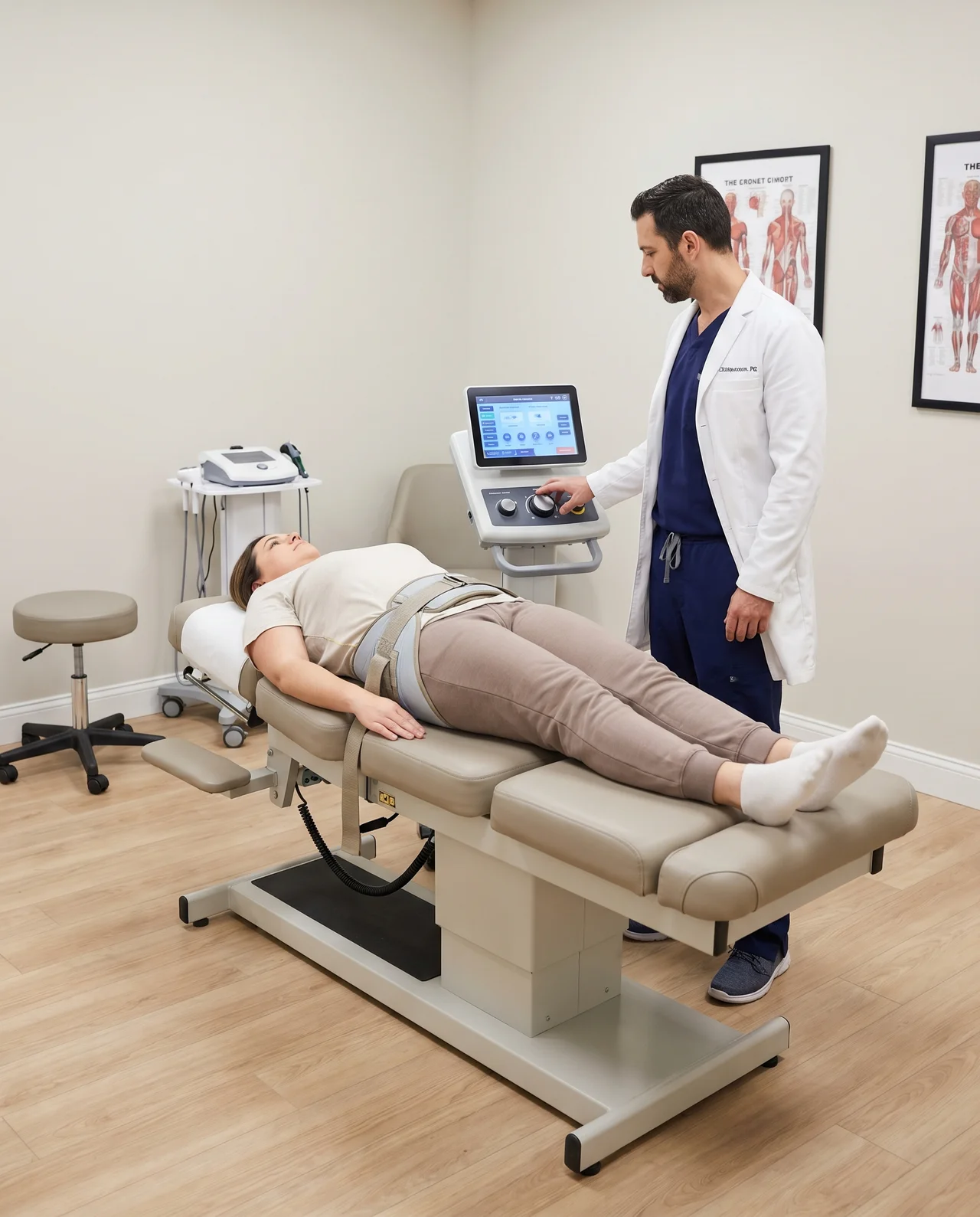
Spinal decompression is a specific protocol - not "just traction." A controlled, computer-driven cycle of pull and release creates negative pressure inside the disc space, which helps retract herniated material and draws water and nutrients back into the disc. Over a course of sessions, the disc can actually heal.
A disc herniation happens when the soft inner portion of a spinal disc pushes through the tough outer ring, often pressing on a nerve root. Rest alone rarely resolves it - the disc material tends to stay where it is or migrate further. Surgery (microdiscectomy, fusion) works but carries real risk and a long recovery.
Decompression sits in the middle: non-invasive, specifically targeted, and strong clinical evidence for both herniated and bulging discs. Most candidates see meaningful reduction in pain and radiculopathy within 2–3 weeks, and full resolution in 6–10 weeks.
Free consultation including imaging review. A full decompression course (15–25 sessions) typically runs $2,000–$3,500 depending on complexity, often with some insurance coverage. We verify benefits and give you exact out-of-pocket cost before starting.
Compare this to surgery: a single microdiscectomy averages $15,000–$30,000 out-of-pocket after insurance, with weeks of recovery and real procedural risk. When decompression is an option, it's worth trying first.
What Patients Say
Neurosurgeon said fusion was my only option. Eight weeks of decompression here and my MRI shows the disc is back where it belongs. No surgery.Patrick O.L5-S1 Herniation
Bulging disc and sciatica down my left leg. Couldn't sit for more than 10 minutes. After the course, I'm back to full workouts.Linda E.Bulging Disc
The sessions themselves are actually relaxing. I fell asleep on the table multiple times. And it works.Tom F.Disc Degeneration
FAQ
Spinal decompression uses a motorized traction table to gently stretch and decompress the spine in a controlled pattern, creating negative pressure between vertebrae that helps retract herniated disc material and draw in nutrients for healing.
No. Most patients describe decompression as relaxing - many fall asleep during sessions. You lie on a padded table while the machine does the work.
A typical course is 15–25 sessions over 6–10 weeks, usually starting at 3x/week and tapering down. We re-exam mid-course to verify you're responding before completing the protocol.
For many herniated-disc and bulging-disc cases, yes. Research and our clinical experience show decompression helps most patients avoid surgery. That said, some cases (cauda equina, severe nerve deficit, large extrusions) need surgical evaluation - we screen for these before starting care.
Comprehensive non-surgical care for low-back nerve pain.
Learn more →Spinal manipulation alongside decompression for best outcomes.
Learn more →Post-collision disc injury recovery.
Learn more →Cervical decompression also available for neck-disc issues.
Learn more →Free consult with MRI review. Find out if you're a candidate.
Book Free Consultationor call (737) 245-0177